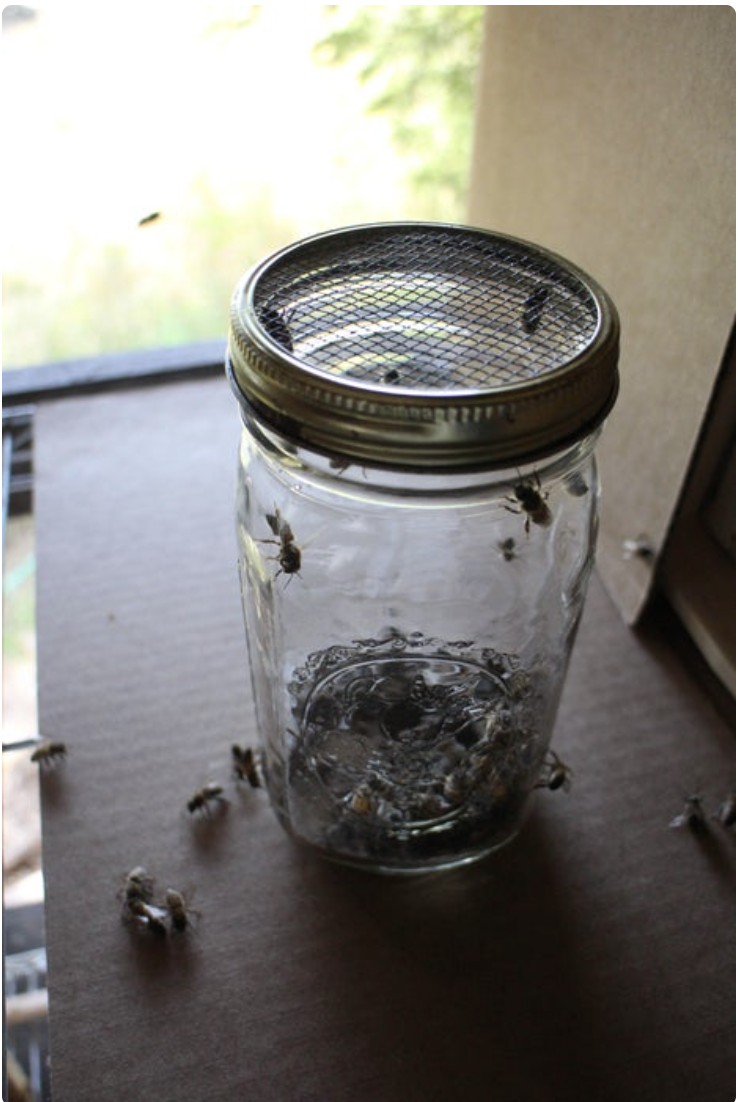
- Remove a brood frame from the hive, not a frame with honey or pollen, checking to ensure the queen is not present.
- Brush or shake bees into a tub, waiting about a minute for the older forager bees to fly off. This step will substantially increase the probability that tested bees are infested.
- Scoop about one-half cup (300 bees) into the jar.
- Add approximately one heaped tablespoon of powdered sugar (or icing sugar) into the jar.
- Secure mesh lid onto the jar.
- Virgorously shake the jar for one minute, to cover the bees in sugar and dislodge the mites from the bees. Sugar-covered bees must be vigorously shaken, to the extent that some may die. Otherwise, the mites may not dislodge, giving a false negative test. Your arm will get tired, so take a rest after 20 seconds.
- Set the jar down and wait three to five minutes. Rushing the process increases the risk that an infestation will not be detected.
- Invert the jar and vigorously shake it like a saltshaker over a pan of water. It is better to shake over water since any mites will float on top and will be easier to identify. The sugar will also dissolve in the water, making mite detection easier.
- Add another tablespoon of powdered sugar to the jar, shake and roll the bees again for 30 plus seconds repeating the shake into the pan of water. This improves the sensitivity of the test.
- Inspect the pan of water to visualize any mites are floating on the surface. There may also be dirt floating , so glasses or a magnifying glass may be needed.
- Release the bees that have been tested into the top of their colony or at the colony entrance.
- Since we are estimating the number of traveler (phoretic) mites per 100 bees, if we sampled 300 bees (1/2 cup) and found say, nine mites, the rate of infestation would be 9 per 300 = 3 mites per 100 bees.