Creating a honey bee management plan is crucial to successful beekeeping. This plan is developed for the Columbia Gorge Region (northern Oregon – Southern Washington). The region spans from Portland Oregon east to Goldendale Washington. The geography shifts from a moist coastal climate to desert like.
Varroa destructor mites arrived in the United States in 1987, that is 39 years ago. The War On Mites has only resulted is increasing colony losses. Key is a robust plan designed to improve nutrition, health and diminish Varroa mite loads.
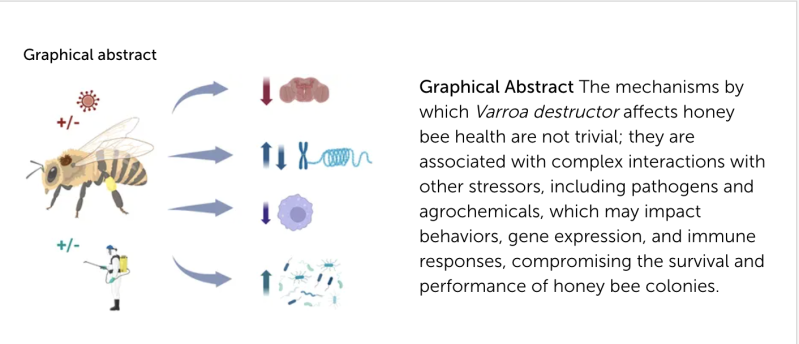
Varroa destructor and its impacts on honey bee biology
The goal of the plan is to anticipate the chemical needs, purchasing ahead in case treatment is required. Just as importantly, is the other issues to include nutrition, what foliage is in bloom offering nectar and/or pollen.
A significant resource is the Honey Bee Health Coalition Varroa Management Guide
The honey bee season begins in January and ends in December. The months of November to January, the queen takes a siesta from laying eggs. Around mid-January the queen restarts her egg laying with around 400 eggs per day. She must replace the ‘winter bees’ (approximately 10,000), then build the ‘summer bees’ upward to about 50,000.
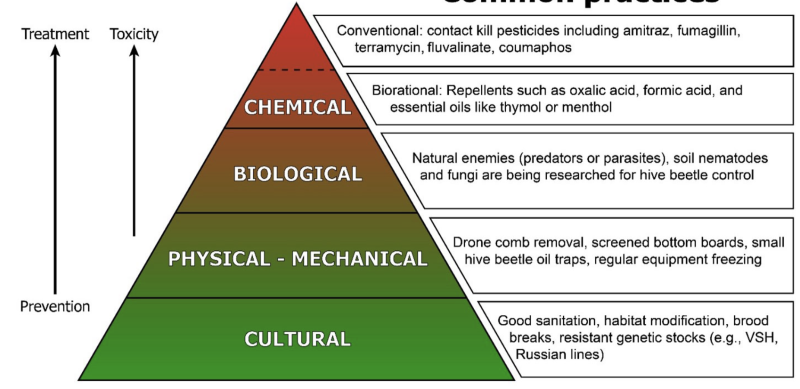
Integrated Pest Management practices include:
Awareness
- conducting research into colony pest and diseases to become more vigilant toward identification and courses of action.
Monitoring
- assessing Varroa destructor mite loads is essential. Sampling for Varroa Mites . Monitoring should be performed at least monthly from April through October. It is also critical to assess two weeks post treatment to determine efficacy.
Treatment Thresholds
- Varroa monitoring thresholds for the months of April through August are 2 mites per 100 bees sampled. September and October thresholds are 3 mites per 100 bees sampled. For the months of April through June Varroa mites have a 8 to 11 times greater possibility of infesting a drone brood cell than a worker brood cell.
Solutions
- Should the Varroa mite loads exceed the threshold solutions to reduce the infestation may include the following:
- Requeening
- Supplementary feeding
- Quarantining
- Reducing stress
- Screened Bottom Boards
- Reducing condensation within the hive
IPM Actions
Biological
- Naturally occurring predators, parasites, and bacteria are included in this group. Varroa Sensitive Hygiene Queens bred for their ability to create daughters with enhanced abilities to detect and remove Varroa. Norroa is powered by vadescana, a new Mode of Action (MoA) for beekeeping based on RNAi.
Cultural
- Manipulate colony in order to reduce pests and diseases.
- Space colonies far apart
- Week Control
- Sanitation around the hive
- Traps (Yellow Jacket)
- General hygiene
Chemical Control
- Chemical control includes several miticides categorized as “soft” and “hard”. The choice is determined by the infestation levels, time of season, and ambient temperature.
- Consult the Honey Bee Health Coalition Varroa Management Guide for best choice based on the season.
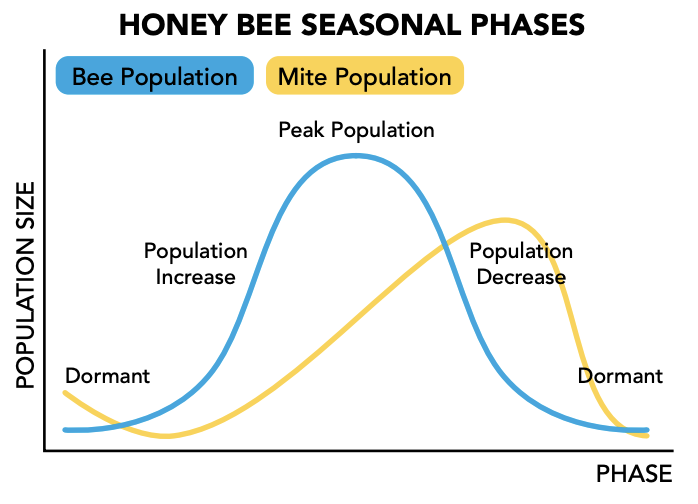
Honey bees and their parasitic varroa mite cycle through four temporal phases. In some locations, there is one cycle of these four phases per year and, in other locations, more than one cycle.
The phases are:
- Dormant
- Population Increase
- Population Peak
- Population Decrease
JANUARY
- Weigh hive by lifting from the back and bottom board to assess hive weight
- Begin emergency feeding with frames of honey, sugar candy, dry sugar, or Hive Alive if necessary.
- Clean, paint, and repair equipment
- Check apiary for vandalism, hive covers blown off, and so forth
- Read external entrance hive
- Order packages, nucs, queens, if not done in December; and of course required
- Consider your mite and disease management program and order / construct the necessary materials (screen bottom boards, drone foundation, chemicals, sugar shake supplies, and so on)
FEBRUARY
- Weigh hive by lifting from the back and bottom board to assess hive weight
- Check colonies for honey stores
- Continue emergency feeding with frames of honey, sugar candy, dry sugar, or Hive Alive if necessary.
- Read external external hive
- Continue to prepare equipment for coming season
- Conduct Post Mortem on dead colonies and clean them up Dead Colony Forensics
MARCH
- Weigh hive by lifting from the back and bottom board to assess hive weight
- Continue emergency feeding with frames of honey, dry sugar, or Hive Alive if necessary.
- Read external entrance hive
- Feed Pollen Substitute Patty, if needed
- First quick inspection of brood nest, if weather permits (temps above 50 degrees for 3 consecutive days)
- Check for dead colonies, conduct post mortem, clean up
- Conduct Post Mortem on dead colonies and clean them up Dead Colony Forensics
- Put out Yellow Jacket/Wasp traps
- Clean out entrances and bottom boards
- Assemble section honey supers
<
APRIL
- Monitor colony stores, especially if weather is cold and wet
- Monitor colony for Varroa destructor mites – Sampling for Varroa Mites
- Inspect brood nest for laying queen, disease, and so forth
- Monitor colonies for queen cells
- Introduce package bees on drawn comb
- Requeen colonies with VSH queens
- Reverse brood chambers when weather moderates
- Add supers to strong colonies at time of maple or dandelion bloom
- Equalize strength of all colonies
MAY
- Monitor colony for Varroa destructor mites – Sampling for Varroa Mites
- Monitor colonies for queen cells
- Control swarming
- Add more supers as necessary (oversuper)
- Place queen excluder below shallow super on colonies for comb honey
- Install packages or foundation
- Split strong colonies
- Capture swarms
- Cull and replace defective combs with full sheets of foundation
- Begin implementing an Integrate Pest Management Program for the control of mites
JUNE
- Monitor colony for Varroa destructor mites – Sampling for Varroa Mites
- Continue to check for queen cells
- Rear queens if you prefer your own stock
- Check colonies for disease and monitor for mites
- Remove comb honey supers when properly sealed (capped)
- Provide plenty of super space
- Control swarming
- Capture swarms
JULY
- Monitor colony for Varroa destructor mites – Sampling for Varroa Mites
- Remove comb honey supers when properly sealed (capped)
- Check for queen cells, especially in colonies used for queen rearing
- Add sufficient super space (undersuper)
- Remove and extract early season honey crop
- Freeze comb honey to prevent wax moth damage
AUGUST
- Monitor colony for Varroa destructor mites – Sampling for Varroa Mites
- Check colonies for disease and monitor
- Remove and extract summer honey crop
- Remove section supers
- Do not work bees unless necessary to avoid robbing
- Add more supers if needed
SEPTEMBER
- Monitor colony for Varroa destructor mites – Sampling for Varroa Mites
- Check colonies for disease and monitor
- Provide supers for fall goldenrod and aster flows
- Requeen colonies with VSH Queens
- Unite (combine) weak colonies
OCTOBER
- Monitor colony for Varroa destructor mites – Sampling for Varroa Mites
- Prepare colonies for winter
- Begin fall feeding with heavy syrup (2:1) if needed
- Continue emergency feeding with frames of honey, dry sugar, or Hive Alive if necessary.
- Unite weak colonies with stronger colonies
- Put on entrance reducers to keep out mice
- Extract fall honey crop
NOVEMBER
- Finish handling honey crop
- Order new equipment for coming season
- Consider an Oxalic Acid Vaporization
- Develop and implement your honey (and other hive products) marketing program, especially for the holiday season
- Begin late-fall feeding: Hive Alive and/or Pollen Substitute Patty
- Weigh hive by lifting from the back and bottom board to assess hive weight
DECEMBER
- Consider an Oxalic Acid Vaporization
- Weigh hive by lifting from the back and bottom board to assess hive weight
- Repair and assemble hive equipment
- Order packages, queens, nucs, if you know your needs